
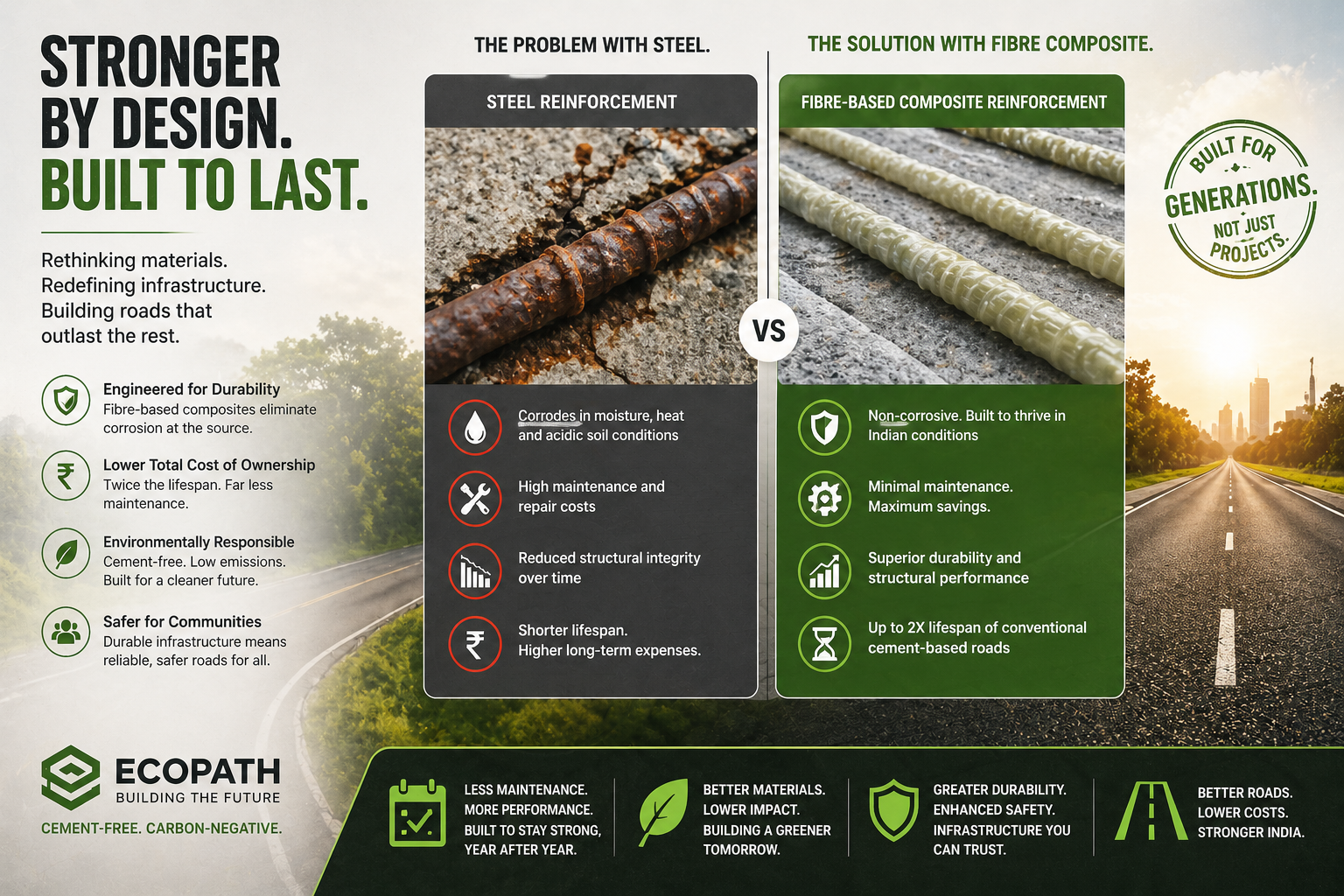
Steel has long been considered the default choice for reinforcement in construction. It is strong, widely available, and familiar to engineers and project managers alike. But over time, its limitations become increasingly visible- especially in Indian conditions, where monsoon moisture, soil acidity, and heat cycles accelerate corrosion in ways that are not always accounted for in early project budgets. Maintenance costs climb. Structural integrity declines. What seemed reliable at the start often demands expensive repair cycles that compound over the lifetime of a road or structure.
Fibre-based composite materials address these problems at the root. By eliminating the corrosion factor entirely, they extend the functional lifespan of infrastructure without the recurring maintenance overhead. Ecopath's adoption of such materials - alongside their broader cement-free product range reflects a philosophy that the best infrastructure is infrastructure you don't have to keep fixing. Their road projects are designed for a lifespan twice that of conventional cement-based alternatives, which changes the math on total cost of ownership significantly.
But the more important shift is conceptual. For too long, the construction industry has accepted material trade-offs as givens: steel corrodes, cement pollutes, roads deteriorate. The willingness to question those assumptions and rebuild the stack from the ground up is what separates a product company from a platform for change. When the material itself is rethought, everything built on top of it changes, too. In a sector where durability directly impacts public safety, choosing materials that outlast and outperform is not just an engineering decision - it is an ethical one.