
The Problem We’ve Learned to Ignore
For decades, cement has been the backbone of construction-trusted, scalable, and deeply embedded in how we build. But its environmental cost has largely been overlooked.
Cement production remains one of the largest contributors to global carbon emissions. Yet, the industry has treated it as non-negotiable. The underlying assumption has always been clear: moving away from cement would mean compromising on strength, cost, or practicality.
As a result, sustainability has often been seen as an aspiration, not something you can realistically build with.
Rethinking the Foundation
Ecopath challenges this assumption at its core-not by improving cement, but by eliminating the dependency.
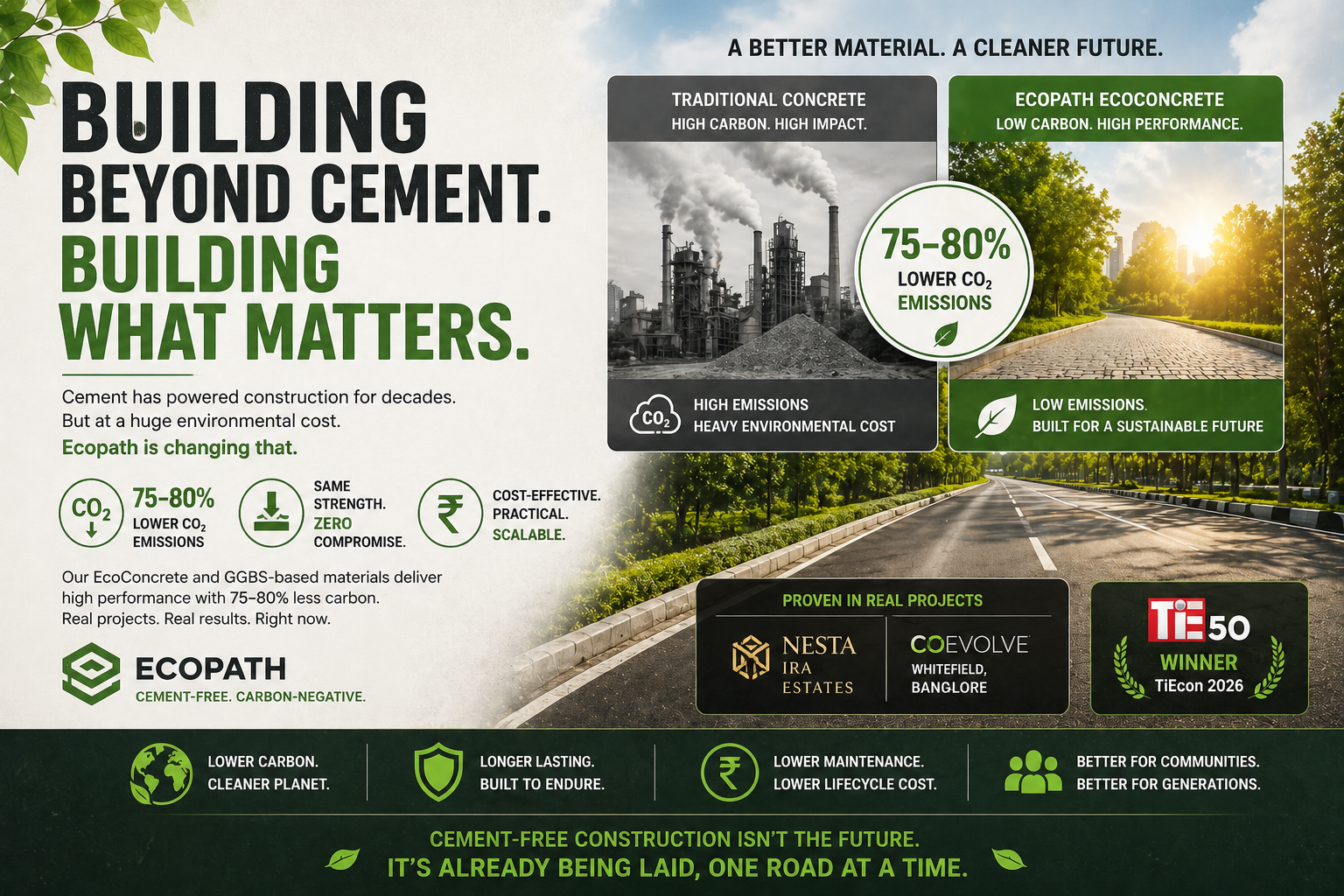
Their EcoConcrete and GGBS-based materials are engineered to match the performance of traditional construction while reducing CO₂ emissions by 75–80%. This is not incremental improvement—it’s a structural shift in how infrastructure is built.
More importantly, this isn’t theoretical.
Real-world projects, including the internal road network at Nesta Ira Estates and CoEvolve’s Whitefield development in Bangalore, have already been completed using these materials—delivering measurable results without compromising durability or cost.
From Sustainability as a Goal to a Default
The real shift is not just technological-it’s behavioural.
When sustainability is built into the foundation of a project without adding complexity or cost, the conversation changes. It is no longer about whether to adopt greener methods, but why not.
This changes how developers think, how projects are evaluated, and how long-term value is defined.
A Signal from the Global Stage
Ecopath’s recognition as a TiE50 winner at TiEcon 2026 further reinforces this shift.
Being selected among the most promising climate tech startups globally signals that cement-free construction has moved well beyond the proof-of-concept stage. It is now being seen as a scalable, credible solution to a deeply rooted industry problem.
Already in Motion
Cement-free construction isn’t a future waiting to arrive.
It’s already being laid-one road at a time.